LOGIN
If you have forgotten your login details please send an email to: info@meatmessaging.com
An introduction to Meat Messaging
Meat Messaging is an industry program administered by AUS-MEAT with program management through an industry committee (RMSCC) comprising representatives from AMIC, AMPC, MLA, AUS-MEAT, DAFF, GS1 and industry members. Meat Messaging has initially been funded through several industry arrangements. In 2017 the industry committee agreed, through consultation, that Meat Messaging was to be funded through a "Cost Recovery" model based on billing for each message uploaded to Meat Messaging. In 2022 the industry committee published this model which included a proposed timeframe and fee structure, along with a process for adjusting the fee structure on a regular basis to maintain Meat Messaging. For more information on the Meat Messaging cost recovery model, contact AUS-MEAT on ausmeat@ausmeat.com.au or 1800 621 903
Meat Messaging mobile app
The Meat Messaging progressive web app (PWA) is designed to work on mobile devices and supports barcode scanning, either through a mobile-device camera or - ideally - through a web-browser-enabled mobile device that has an inbuilt barcode scanner. The Meat Messaging progressive web app can be accessed at https://app.meatmessaging.org/
How does Meat Messaging work?
The IT-management system of a Meat Messaging registered Australian exporting establishment sends a Meat Messaging message - for every shipment that leaves the establishment - to the Meat Messaging portal. The program then holds the meat consignment information in a secure, standards-based industry cloud portal. The Meat Messaging message information that is uploaded to the portal is the same information that can be accessed on the physical carton, case or carcase. The Meat Messaging industry portal is accessed by supply-chain participants and regulatory authorities to determine the authenticity, veracity and traceability of meat products. Refer to the DAFF Meat Notices for more details, available here. The uploaded message information can be accessed by the client or import inspection facility in advance, through the Health Certificate or carton/case/pallet barcode information.
The Meat Messaging program is based on the use of GS1 barcoding standards and GS1 EANCOM electronic message standards. These GS1 standards do not replace existing regulatory requirements - they assist and supplement these requirements. For more details of the GS1 standards, as they apply to the Meat Industry, refer to the RMSCC website, available here. Once a company has registered to use Meat Messaging, they must demonstrate competence in using the Meat Messaging web portal in the test environment. After this process is complete, they will receive approval from DAFF and FSIS, and the Australian Meat Exporting Establishment will be listed on the FSIS Import Inspection Operations SharePoint site. This allows for approval to rectify missing shipping marks on cartons through this FSIS directive.
Introduction to Meat Messaging Learning Resource
The "Introduction to Meat Messaging" Learning Resource is a comprehensive, interactive training program designed to empower learners with the knowledge needed to effectively implement the Meat Messaging system for use with export messages, eMTCs and domestic messages.
An export establishment's key personnel need to have completed the Introduction to Meat Messaging course before the export establishment can move from the implementation or testing phase to commercial and regulatory use of the Meat Messaging system. For more information on the Meat Messaging Learning Resource go to the AUS-MEAT Training Portal.
12 commercial benefits of using Meat Messaging
1. Ability to remark damaged or missing shipping marks to the U.S.
For the U.S. market, Meat Messaging is used for remarking damaged or missing shipping marks which immediately allows the lot to move as a unit.
Outline for:
Australian export establishments
U.S. import inspection establishments
2. Send cartons to the U.S. without shipping marks
For the U.S. market, Meat Messaging can be used for compliance to the FSIS protocol for sending cartons without needing to apply shipping marks to individual cartons.
Outline for:
Australian export establishments
U.S. import inspection establishments
3. Government-recognised traceability validation tool can be used to respond to issues raised by government agencies
Meat Messaging provides traceability validation from the export-registered meat establishment all the way to the end user.
Outline for:
Australian export establishments
U.S. import inspection establishments
4. Carries product provenance claims
Greatly increased end-user visibility of supply-chain movements, improved traceability and product provenance validation.
Outline for:
Australian export establishments
Cold stores
Non-packer exporters
Foreign import countries
5. End-users can access shipment information before it arrives
Meat Messaging provides a simple solution for supply-chain visibility as it allows the end-users to access all the production data for a shipment before that shipment arrives.
Outline for:
Australian export establishments
Cold stores
Non-packer exporters
Foreign import countries
6. Acts as a Product Translation Tool for Foreign Speaking Countries
Meat Messaging makes meat trading easier for countries that don’t speak English.
Outline for:
Australian export establishments
Cold stores
Non-packer exporters
Foreign import countries
Government
7. Reduce time taken on MTCs
Establishments that have started using eMTCs, through integration with their on-plant systems, have seen MTC-management time drop from hours per day to no time being spent on MTCs at all.
Outline for:
Australian export establishments
8. Reduced time taken on manual paper recording
Time taken at loadout for manual paper recording of activities for export loads, MTCs and domestication has all but vanished for establishments that have fully implemented Meat Messaging through integration with their on-plant systems.
Outline for:
Australian export establishments
Cold stores
Non-packer exporters
9. Real-time assurances on product safety and integrity
Meat Messaging's capacity to provide real-time assurances on product safety and integrity also provides the ability to move seamlessly to annual DAFF audits.
Outline for:
Australian export establishments
Cold stores
Non-packer exporters
Foreign import countries
Government
10. Ensure market eligibility at a carton level
Meat Messaging ensures and demonstrates market eligibility through the export supply chain - from the processor through to the importing country inspection - for every carton.
Outline for:
Australian export establishments
Cold stores
Non-packer exporters
11. All the information that is on a paper or electronic certificate
Importers and end-users still rely on paper certificates or data from eCert - the system provides all the information that is on a paper or electronic certificate.
Outline for:
Australian export establishments
12. Future potential for regulatory changes in lab sampling
The system allows for further possible regulatory changes (next steps) to sampling and inspection methods.
Outline for:
Australian export establishments
Cold stores
Non-packer exporters
Government
How Meat Messaging enables official import facility remarking in the U.S.A
The industry portal - and related activities - are documented in Australian Meat Notice 2018-01 and meet the requirements of FSIS Directive 9900.5, Section VII, E.Procedures for Correcting Shipping Marks when Using Barcodes for the use of the industry portal for carton/carcase verification.

Correcting shipping marks
- Import establishments can correct shipping marks without having a representative of the foreign government to supervise
- This can be done when FSIS can verify the unique identifier within a barcode on the shipping unit, using supporting documentation from the foreign country.

Supporting documents available
- Supporting documentation is available for Australian products through Meat Messaging
- Meat Messaging can be accessed by an import establishment to view barcodes linked to the certificate
- Same day at no cost.

Available to eligible countries
- Meat Messaging is only accessible in countries that are eligible and only to establishments approved for such activity
- Australia is eligible - FSIS inspection personnel verify eligibility through a list of approved Australian establishments maintained in the FSIS internal SharePoint site.

Replace Paper MTCs
- The industry portal and related activities are documented in Australian Meat Notice 2018-01 and meet the requirements of FSIS Directive 9900.5 for the use of the industry portal for carton/carcase verification.
- Under “Section E. Procedures for Correcting Shipping Marks when Using Barcodes”, FSIS permits official import inspection establishment personnel (IPP) to apply the shipping mark to shipping units without having an official representative of the foreign inspection system on site to approve and observe this activity.
- This is possible when FSIS IPP can verify the unique identifier within a barcode on the shipping unit, using supporting documentation provided by the foreign country.
Australian meat exporters can now send cartons to the U.S. without shipping marks on individual cartons.
FSIS Directive 9910.1 states that Australian exporters can use placards on slip-sheet, shrink-wrapped pallets associated with all the individual cartons or cases. Shipments complying with this directive are to move intact to official establishments within the U.S. for further processing. This process provides the required level of carton traceability. Pallets and placards are used instead of applying individual shipping identification marks to each meat carton or case. The placard acts as the identification linked to the Health Certificate.
Current process
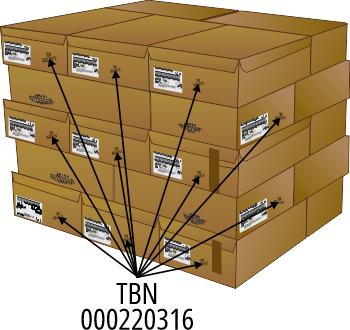
Australian shipping marks
Instead of Australia applying their shipping marks on products shipped to the U.S., the barcodes on the pallet placard and individual cases will be used to verify approved Australian product.
USDA official import mark
Instead of applying the USDA official import mark of inspection to the individual cases, the mark is applied only to the barcode placard on each pallet in the shipment.
Pallet wrapping
Inspection personnel will perform label verification without removing the plastic wrapped around the pallet, as long as the label attributes are visually identifiable.
Slip sheets
Placing slip sheets on each crate when loading and unloading is pivotal. Slip sheets need to be on the top and bottom of the block, with machine wrap, whether placing the block into the container or removing it from the container.
FSIS Directive 9910.1 process
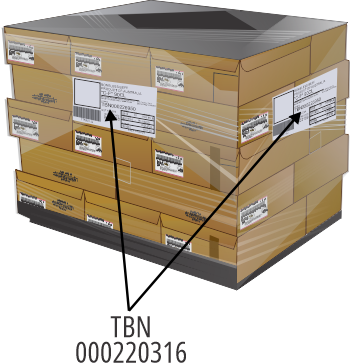
The Meat Messaging Pallet Pilot
Download the Pallet Pilot Report
Reducing labour costs through slip sheets
The Meat Messaging Pallet Pilot used slip-sheet pallet labels with a Serial Shipping Container Code (SSCC) as a replacement for individual carton/case shipping marks.
The time saving for the unloading/inspection has been shown to be reduced to 2 people for 45 minutes instead of 5 people for 45 minutes to unload a container.
U.S.A demonstrated this in a 2019 Pallet Pilot to Philadelphia.
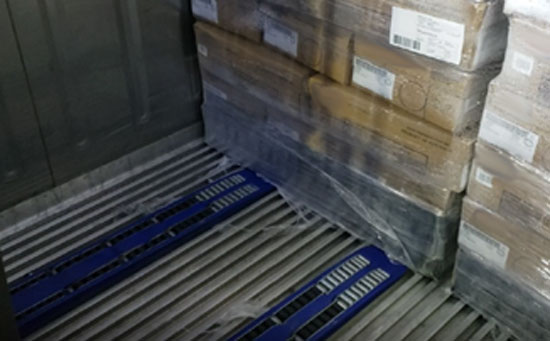
Damaged pallets without slip sheets
In the final shipment of the latest Pallet Pilot, three boxes were rejected from the shipment because the tops of the boxes were ripped from the "teeth" of the forklift through human error.
The Pallet Pilot images below show the damage that can be done without having a slip sheet on the top of the crate. Pallets must have slip sheets placed on the top and bottom.
Care needs to be taken when loading them, ensuring the sides of the stacked pallets are even with each other. The pallet’s plastic wrap will help maintain this even stacking and provide a protective layer around the cases.
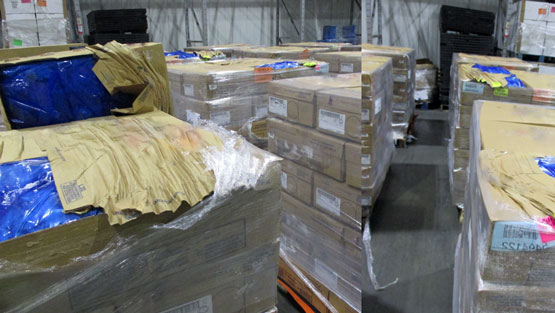
Cartons with pallet stacked on top damaged by forklift.
Using roller forks for loading and unloading: how do they work?
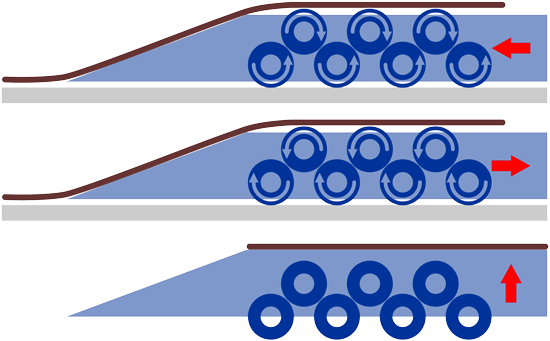
The roller forks can be used for pallet-free handling. Roller forks are standard lift-truck forks with two layers of rollers. When the under-most row of rollers touches the floor, it causes the uppermost rollers to rotate in the opposite direction, whereby the forks slide under the slip sheet without disturbing the products.
When the forks are lifted up, the rollers 'fall' downwards and place the products securely on the upper side of the forks, enabling the products to be unloaded in the opposite order - this also works with shipping container floors.
A roller fork consists of a special lift-truck fork that serves as a supporting frame with a special hinge in the heel allowing it to always lay flat on the floor. Inside the fork are two layers of rollers - one on top of the other - that drive each other when the forks are moved over the floor.
The basic principle is that the upper rollers rotate at exactly the same speed as the lower rollers, which are in contact with the ground, but in the opposite direction. When the roller forks are lifted up from the ground, the rollers automatically drop and the load is held on the forks.